Carregando...
Carregando...
Carregando...
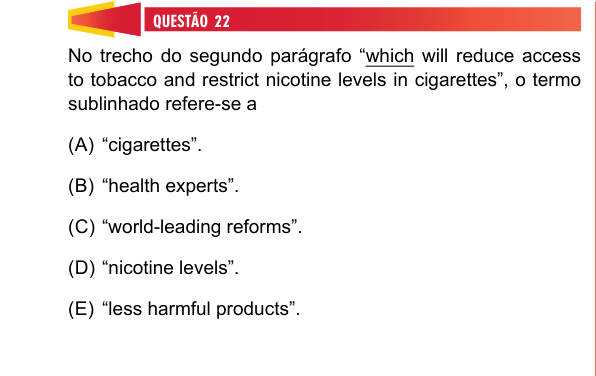
No trecho do segundo parágrafo “which will reduce access to tobacco and restrict nicotine levels in cigarettes”, o termo sublinhado refere-se a
Explique melhor esta questão
Abre o Tutor com o enunciado e as alternativas já no campo — você revisa e envia.
Esta questão foi verificada por um de nossos administradores.

Alternativa (C) - “world-leading reforms”
A questão proposta exige a identificação do antecedente de um pronome relativo, especificamente "which", em um trecho do texto. Compreender a função dos pronomes relativos é fundamental para a correta interpretação textual, pois eles atuam como conectores, ligando uma oração subordinada a um termo ou ideia previamente mencionado no discurso, evitando repetições e adicionando informações cruciais.
Na língua inglesa, pronomes relativos como "which", "who", "whom", "whose" e "that" são utilizados para introduzir orações subordinadas adjetivas (relative clauses). Essas orações fornecem detalhes adicionais ou essenciais sobre um substantivo ou pronome (o antecedente) que as precede. O pronome "which" é comumente empregado para se referir a coisas, conceitos, ideias ou animais, e não a pessoas. A identificação precisa do antecedente de "which" não depende apenas da proximidade gramatical, mas também da coerência lógica e semântica dentro do contexto da frase. É necessário que a ação ou característica descrita na oração relativa seja atribuível ao antecedente escolhido.
Vamos analisar a frase completa e cada alternativa para determinar o antecedente correto de "which":
A frase em questão é: "The government has announced a suite of bold new world-leading reforms to create a smokefree generation, which will reduce access to tobacco and restrict nicotine levels in cigarettes."
| Alternativa | Análise
This is an English text analysis question, specifically about pronoun reference. The phrase is "which will reduce access to tobacco and restrict nicotine levels in cigarettes". We need to find what "which" refers to.
Let's look at the surrounding text. The sentence is: "The government has announced a suite of bold new world-leading reforms to create a smokefree generation, which will reduce access to tobacco and restrict nicotine levels in cigarettes."
The pronoun "which" introduces a non-restrictive relative clause (set off by a comma) that provides additional information about the preceding noun phrase.
Let's evaluate the options: (A) “cigarettes”: If "which" referred to "cigarettes", the sentence would imply that "cigarettes" themselves will reduce access to tobacco and restrict nicotine levels. This is nonsensical. Cigarettes are the subject of the restrictions, not the agent of the reforms. (B) “health experts”: The term "health experts" is not directly preceding "which". The sentence is about "the government" and the "reforms" it announced. (C) “world-leading reforms”: This is part of the noun phrase "a suite of bold new world-leading reforms". Grammatically and logically, the "reforms" are the actual policies or actions implemented by the government that will reduce access to tobacco and restrict nicotine levels. This fits perfectly. (D) “nicotine levels”: "Nicotine levels" are a target of the restriction, not the entity that performs the action of reducing access or restricting levels. If "which" referred to "nicotine levels", it would mean "nicotine levels will reduce access to tobacco and restrict nicotine levels in cigarettes," which is illogical. (E) “less harmful products”: This phrase does not immediately precede "which" in the given sentence fragment. The relative clause is modifying something directly related to the announcement.
Therefore, the term "which" refers to the "world-leading reforms" because these reforms are the mechanism through which access to tobacco will be reduced and nicotine levels restricted.
Alternativa (C).